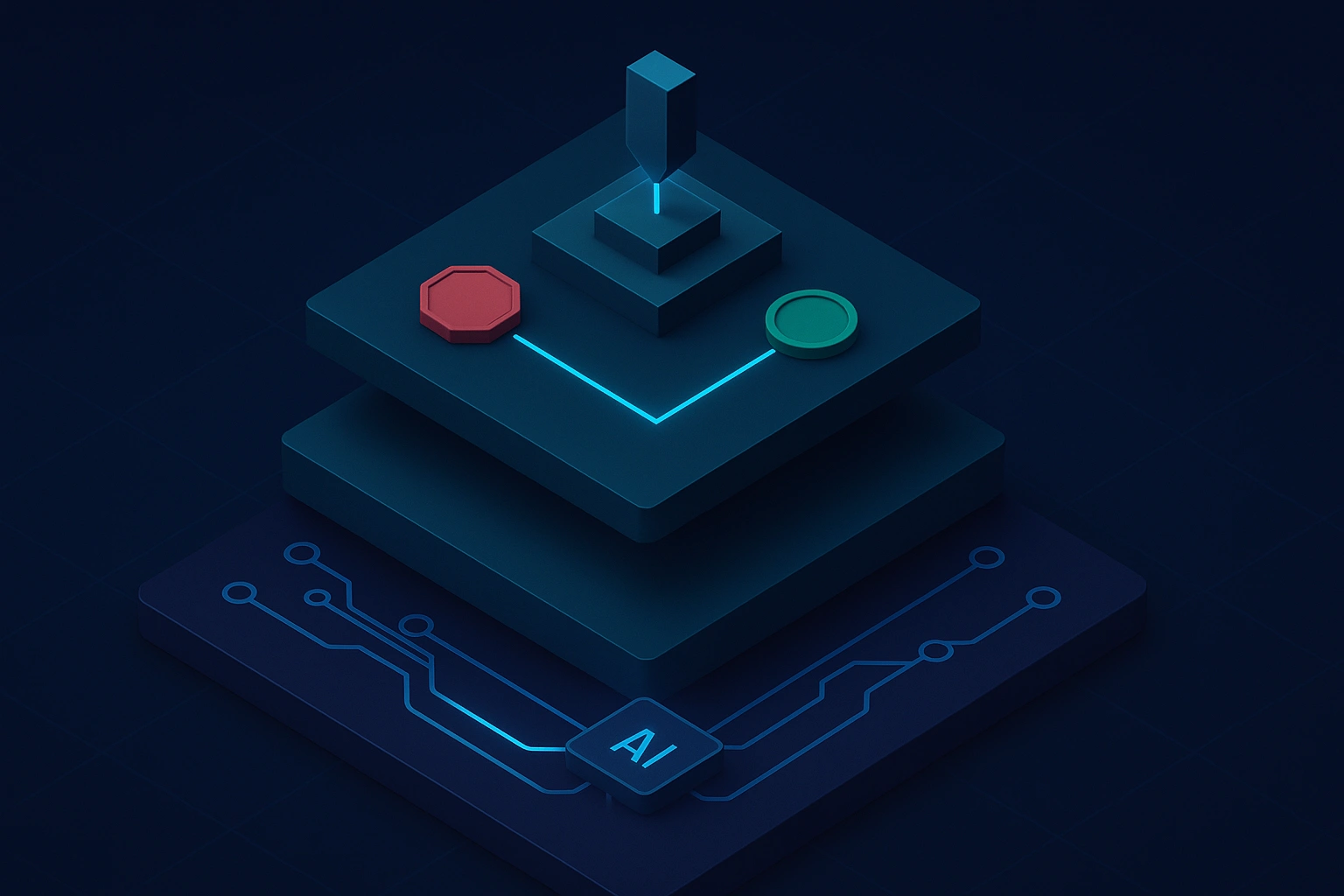
What "in the loop" actually means
The phrase comes from control theory, where a "loop" is the cycle of sensing, deciding, and acting. To be "in the loop" is to be a mandatory node in that cycle: the loop cannot close — the action cannot complete — until the human acts.
This distinguishes HITL from passive review. A dashboard that logs what an AI did is monitoring; it does not place a human in the loop. A workflow that pauses an AI agent before it executes a payment, sends an email, or deletes a record, and requires explicit approval to proceed, does. The defining property is that human judgment gates the action, not that a human can read about it afterward.
The level of human involvement sits on a spectrum, and the terminology is precise:
| Human-in-the-loop | Human-on-the-loop | Human-out-of-the-loop | |
|---|---|---|---|
| Human role | Must act before the action proceeds | Supervises and can intervene | None during operation |
| Default behavior | Action blocked until approval | Action proceeds unless stopped | Action proceeds autonomously |
| Latency added | Highest — waits for a human | Low — only on intervention | None |
| Best fit | Irreversible or high-risk actions | Reversible actions needing oversight | Low-risk, high-volume, reversible actions |
| Failure mode | Bottleneck, approval fatigue | Missed window to intervene | Unbounded autonomous error |
These are not interchangeable. Choosing the wrong point on the spectrum either throttles a system with needless approvals or grants autonomy where a single mistake is unrecoverable.
Why HITL matters for AI
For decades, HITL was about model quality — a human labeling training data, correcting a translation, or reviewing a content-moderation decision. That use remains, but the stakes changed when AI systems began to act rather than only predict.
Excessive agency and irreversible actions
Modern AI agents can call tools: send messages, move money, modify databases, provision infrastructure, file tickets. A misclassification by a predictive model can be corrected later. An agent that wires funds to the wrong account, emails a customer list to an external address, or drops a production table has taken an action that may be impossible to reverse. The risk is not that the model is wrong occasionally — every system is — but that a wrong decision is allowed to execute with real-world consequence and no human checkpoint.
This category of risk is recognized in AI security frameworks as excessive agency: granting an AI system more capability, autonomy, or permission than its reliability justifies. HITL is the primary mitigation — a deliberate checkpoint that converts an autonomous action into a proposed action awaiting approval.
Oversight as a regulatory requirement
Emerging AI regulation increasingly mandates meaningful human oversight for high-risk systems rather than treating it as optional. The expectation is not a human who can theoretically intervene, but one positioned and equipped to understand, question, and override an AI decision before it produces a consequence. HITL is the architectural expression of that requirement: a documented, enforced approval step with a record of who decided what.
Where to place approval gates
Placing a human in every loop is impractical — it reintroduces the bottleneck automation was meant to remove and breeds approval fatigue, where reviewers rubber-stamp requests they no longer read. The design problem is selective: gate the actions that warrant it, and let the rest flow.
A sound HITL design routes actions by risk and reversibility:
- Risk tier — High-impact actions (financial transactions, external communications, deletions, permission changes) are gated; low-impact, easily reversible actions are not.
- Reversibility — An action that can be undone cheaply is a candidate for autonomy or human-on-the-loop; an irreversible one warrants a hard gate.
- Confidence — When the AI system's own confidence in a decision is low, or the input is anomalous, the action can be escalated to a human even if it would normally proceed.
- Blast radius — Actions affecting many records, users, or systems at once justify a checkpoint that single-record actions do not.
The trade-off is explicit: latency versus safety. Every gate adds delay and human cost; every removed gate adds autonomous risk. The goal is not to maximize human involvement but to place it precisely where the cost of a wrong action exceeds the cost of waiting.
HITL for agentic AI
In an agentic workflow, the natural place for a human-in-the-loop checkpoint is the tool call — the moment an agent moves from reasoning to acting. Before the agent's chosen tool executes, the runtime can intercept the call, evaluate it against policy, and, for actions above a risk threshold, suspend execution pending human approval.
This pattern preserves the agent's autonomy for routine work while inserting a human exactly where consequence is highest. A well-built approval gate surfaces the full context of the proposed action — the tool, its arguments, the reasoning, and the predicted effect — so the reviewer makes an informed decision rather than a blind yes. The decision itself, including the reviewer's identity and timestamp, becomes part of the audit record, establishing accountability for actions an AI proposed but a human authorized.